Search "garage floor coating" and you will find two words doing most of the work: epoxy and polyaspartic. They look alike on install day. They do not age alike. If you are deciding what to put on a Raleigh garage slab, the difference is worth five minutes.
What epoxy is
Epoxy is a two-part resin that cures hard and bonds well to clean concrete. It is the system most big-box kits and a lot of low-bid installers use, because the material is inexpensive and forgiving to apply. Its weaknesses are the ones that matter in a garage: it is brittle, so it cracks when the slab moves; it is not UV-stable, so a floor that sees afternoon sun through an open door turns amber within a couple of years; and it is prone to "hot-tire pickup," where a warm tire sitting on the floor softens the coating and peels it up when the car backs out. Epoxy also takes three to five days to cure before you can park on it.
What polyaspartic is
Polyaspartic is a newer aliphatic polyurea topcoat. It is roughly four times stronger than epoxy in abrasion testing, stays flexible so it moves with the slab instead of cracking, is fully UV-stable so it never yellows, and resists the oils, brake fluid, road salt and fertilizer that end up on a garage floor. Just as important for a homeowner: it cures fast. Foot traffic in a few hours, vehicles at 24 hours, full chemical resistance within 72. And it cures in cold weather, which means a Raleigh install in January goes on exactly like one in May.
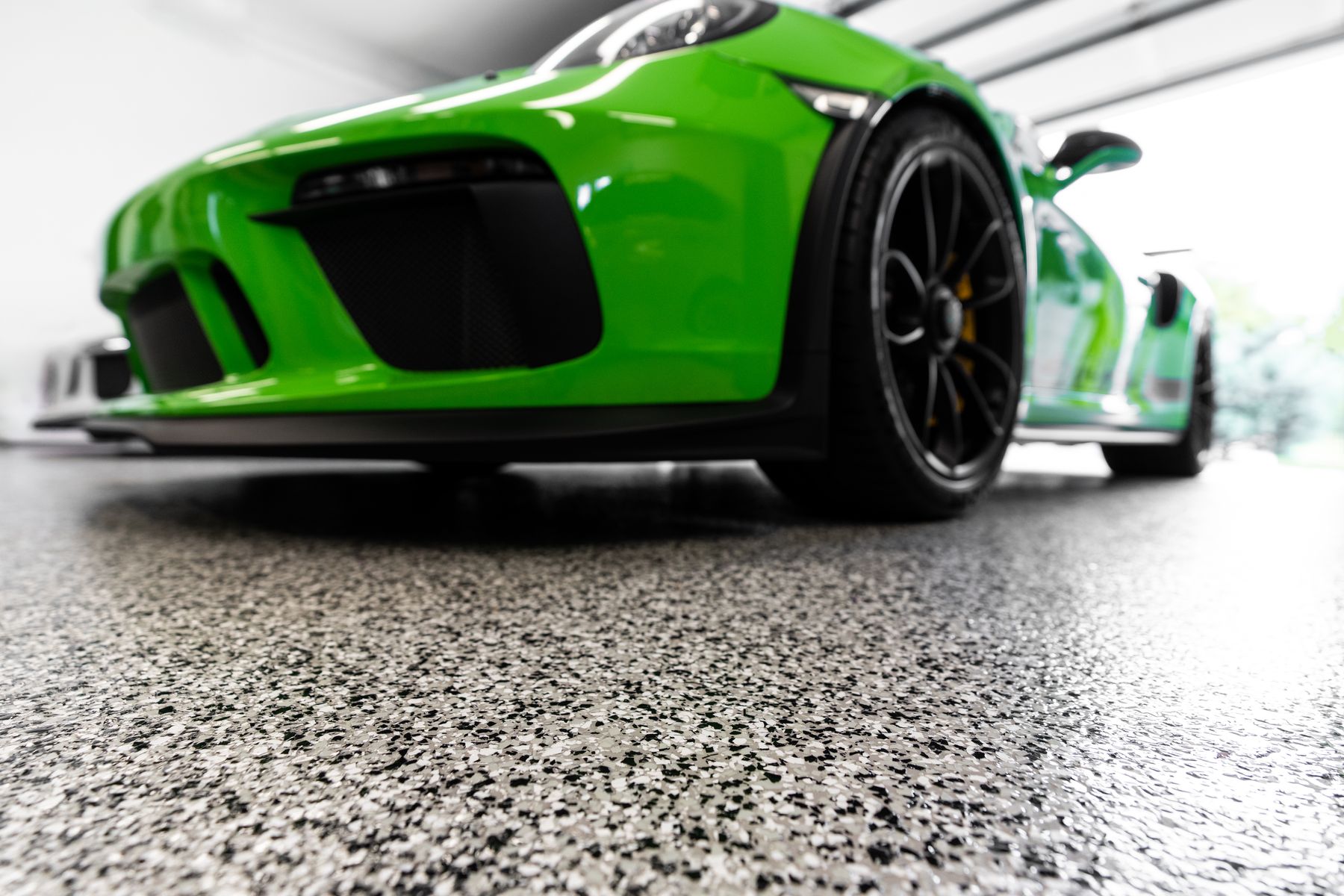
The system Garage On installs pairs a polyurea base coat with a full broadcast of vinyl flake and a clear polyaspartic topcoat. The base coat bonds to the diamond-ground concrete, the flake hides everything and gives you the color, and the polyaspartic topcoat is the layer you actually live on.
What they cost installed
Epoxy is cheaper per gallon, and a kit from a hardware store can be a few hundred dollars. The catch is prep: a kit does not grind the slab, mend the cracks or check for moisture, and most kit floors fail at the prep, not the product. A professionally installed epoxy floor in the Triangle generally lands in the same neighborhood as a polyaspartic floor once the grinding is done properly, because the labor is the same.
Garage On publishes its prices. A two-car Penntek polyaspartic flake floor is $4,700 installed, and a three-car is $7,800, including diamond grinding, crack repair, a moisture check, coated stem walls and steps. On the 24-month no-interest plan that is $196 or $325 a month. There is no estimate visit; the number on the website is the number on the invoice.
Which one should you choose?
If the garage is a place you park cars, store things and occasionally work, polyaspartic is the right floor, and it is the only one we install. If you are coating a basement utility room that never sees sun or tires, epoxy can be fine. For a garage in North Carolina, with hot summers, humid slabs and a door that stands open half the year, the UV stability, flexibility and one-day cure are not nice-to-haves. They are the difference between a floor that looks the same in year ten and one you are grinding off in year three.
How to get one
Pick a package, pick an open date from the live calendar, send a few photos of the floor, and the install is booked. Brian calls to confirm. The full ladder, from the floor alone to a complete conversion with finished walls, lighting, cabinets and a high-lift door, is on the Garage On page.


